

Types of proposal
A brief can propose any of these:
| Type | What it changes |
|---|---|
| Bid | Raise or lower a target’s bid |
| Harvest | Promote a converting search term or ASIN into its own target — as a keyword or as a product target |
| Budget | Change a campaign’s daily budget |
| Enable | Turn a paused target back on |
| Pause | Stop a target running |
| Negation | Block a search term or product target |
| Unnegation | Remove a negative that is no longer right |
| Placement adjustment | Change a placement’s percentage |
| Audience boost | Change an audience adjustment |
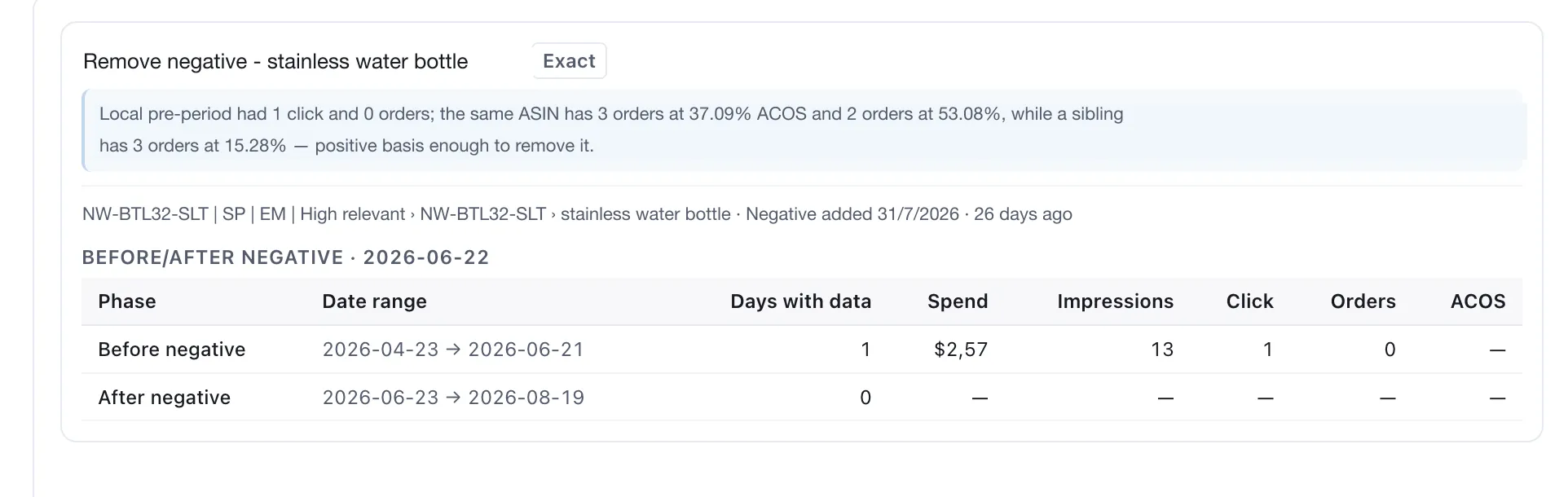
Unnegation carries its own shape of evidence: what the target did before the block, and what it did after.
Every one of these is something you could do yourself in Ads Manager, and something an Automation rule could be configured to do. What differs is how the decision is reached.
The two decisions a rule cannot make
Section titled “The two decisions a rule cannot make”This is the part worth understanding, because it is the reason to read briefs at all.
It resolves what an ASIN target actually is
Section titled “It resolves what an ASIN target actually is”A product target is a ten-character code. You cannot tell from it what the product is, or whether it belongs anywhere near yours.
The Analyst reads the listing behind that code — listings are already among the things it reads — and judges the product against the one being advertised. So a brief can say this target is a ceramic mug, and you are advertising an insulated bottle rather than this target has a bad ACOS.
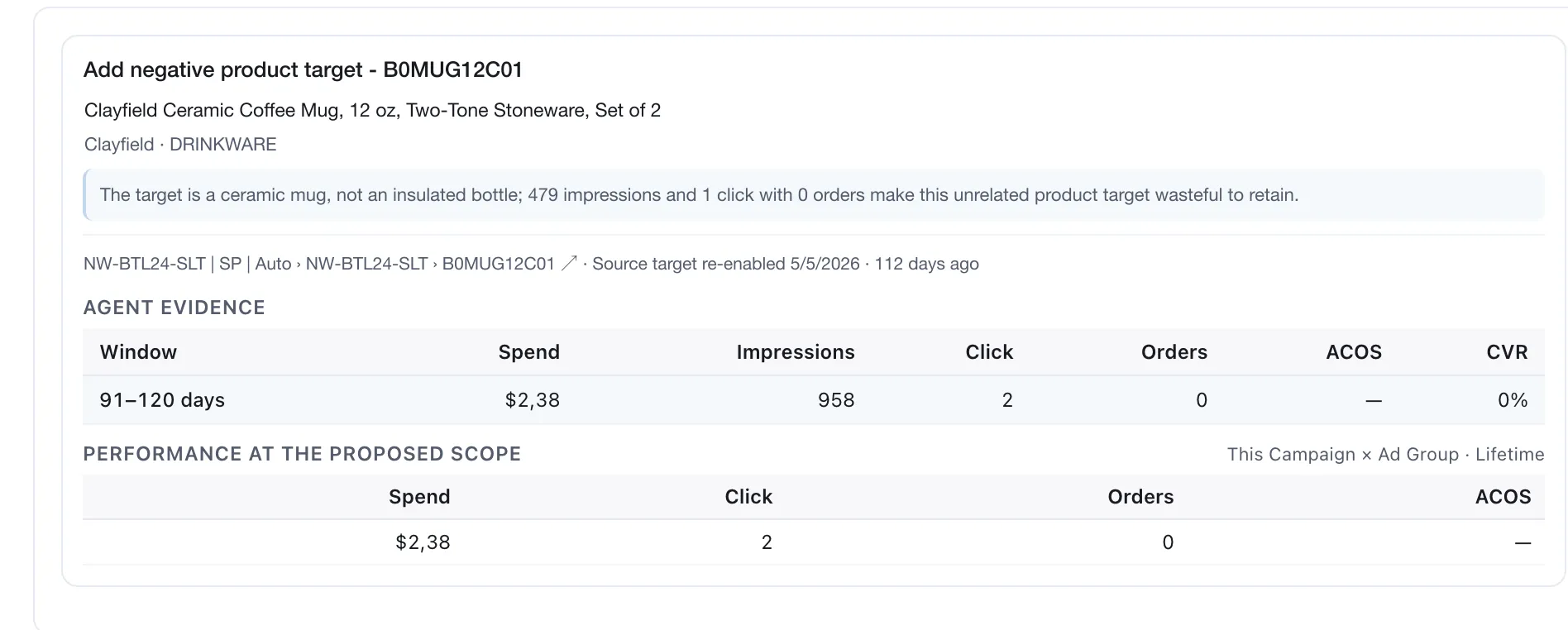
The brief names the product, not just the code. That is the sentence a rule cannot write.
It judges whether a keyword belongs to the product at all
Section titled “It judges whether a keyword belongs to the product at all”That is a question about the product, not a threshold on a metric. No amount of criteria configuration expresses “this search is for a different thing”.
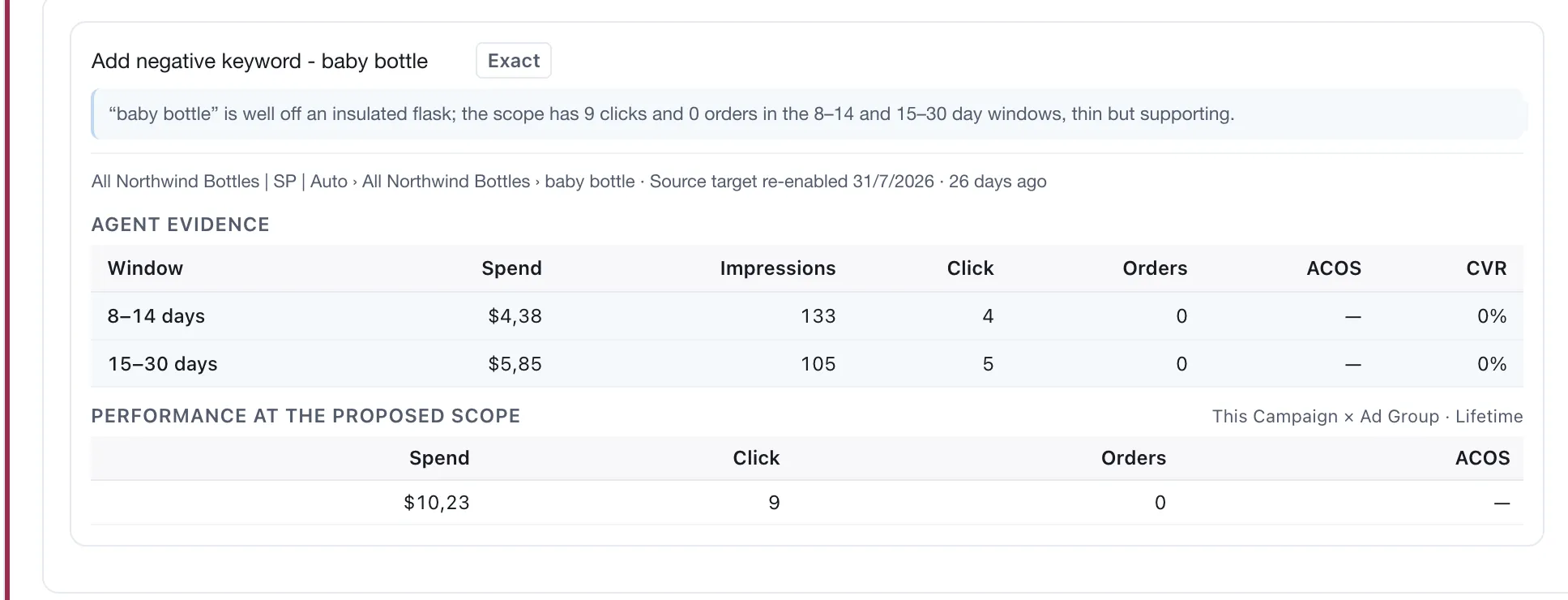
The evidence is thin on purpose — the judgement is about the product, and the clicks are only corroboration.
Why that matters commercially
Section titled “Why that matters commercially”A rule has to wait for proof, and proof is clicks that returned nothing. The target has to spend your money before a threshold can fire on it.
Relevance can be judged before that spend happens. A target that is obviously the wrong product does not need to prove it with clicks first.
That is the argument for briefs over rules on new or unproven targets — not that briefs are smarter, but that they can act on a different kind of evidence.
Where each type fits
Section titled “Where each type fits”Bid and budget are the ones a rule usually handles better, because they are threshold decisions that benefit from running consistently. Read briefs for these when something looks unusual rather than routinely.
Negation and unnegation are where the relevance judgement pays. A rule negates on performance; a brief can negate on what the target is.
Enable and pause are blunt, so read the reason carefully before applying.
Placement and audience adjustments are campaign-level and cannot yet be automated — see the placement and budget rule, which is in development. Until then, briefs are how these decisions get made with evidence attached.
Considerations
Section titled “Considerations”- A proposal is not a prediction. It states what the evidence supports, not what will happen.
- The set above is what a brief can carry today; what appears for your account depends on what the evidence supports.
- Nothing here is applied until you apply it. See Preview Changes.
VendlenPrivacy PolicyTerms of ServiceContact
© 2026 HELODA PTE. LTD. Not affiliated with or endorsed by Amazon.