

Import rule
An Import rule harvests: it takes a search term that has proved itself and creates a keyword or product target for it, so you can bid on it deliberately instead of relying on a broad match to keep finding it.
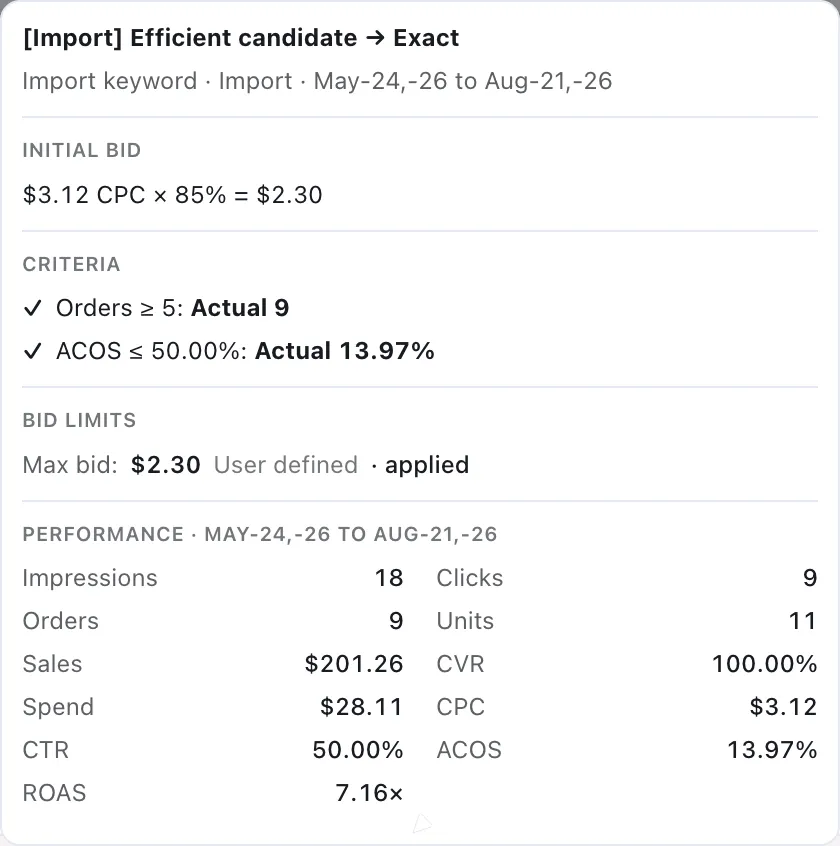
The analysis behind an Import decision names the criteria it matched and the evidence underneath.
What it does
Section titled “What it does”When a search term passes the rule’s Criteria inside the Data Window, the rule creates targeting for it in the ad group the rule is assigned to.
Import runs only from its own Criteria and initial-bid configuration. It does not check the ASIN’s Blacklist or Whitelist; those lists control negative creation, not harvesting.
Configuration
Section titled “Configuration”Where it reads terms from
Section titled “Where it reads terms from”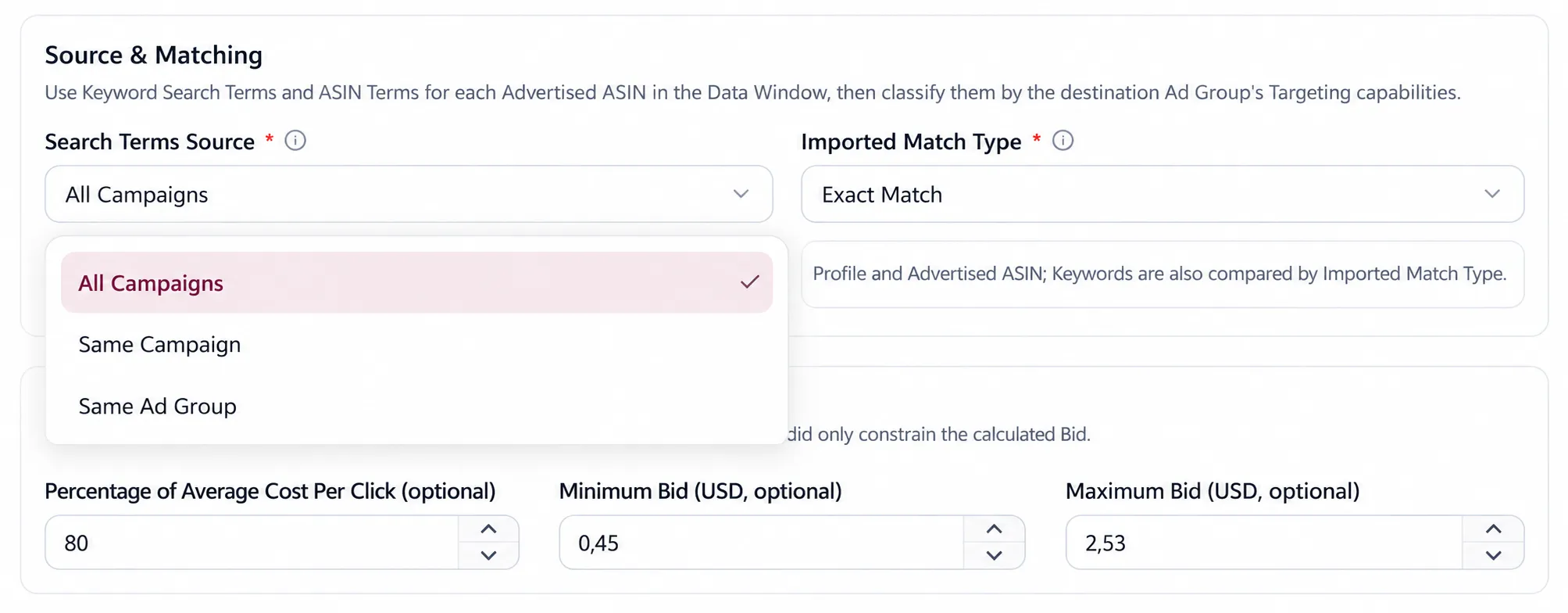
The search terms source decides how wide a net the rule casts. There are three settings: all campaigns advertising the same ASIN, the same campaign as the destination ad group, or only the destination ad group itself. Reading wider finds more candidates; reading narrower keeps the harvest close to where it will run.
Match type
Section titled “Match type”Exact, Phrase and Broad. Exact is usually preferred for harvesting because it keeps bidding
focused on the query that has already been validated, rather than extending to related queries.
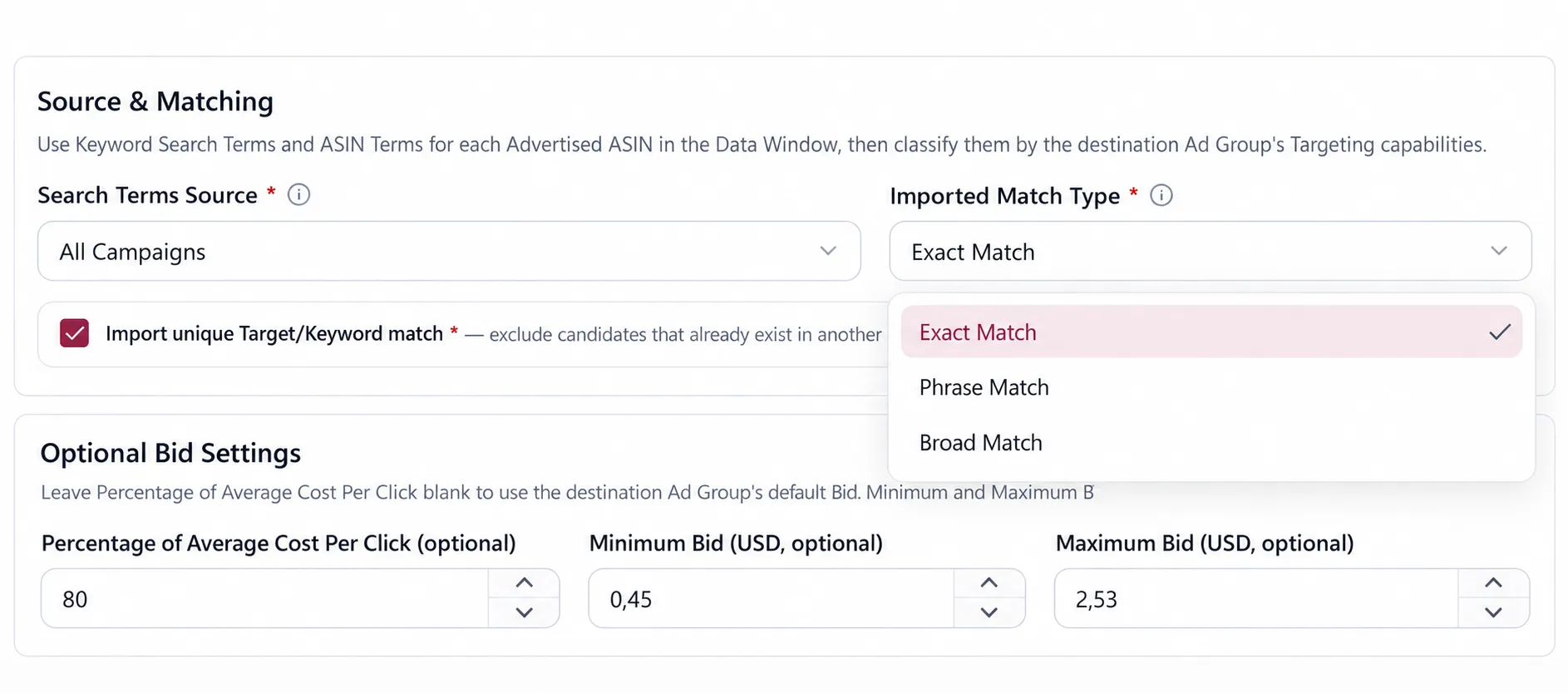
Match type applies to keyword candidates only. An ASIN term is always created as a product target.
The initial bid
Section titled “The initial bid”The new target is priced as a percentage of the term’s own average cost per click. All three bid fields are optional:
| Setting | What it does |
|---|---|
| Percentage of average CPC | The bid, as a percentage of what a click on that term has been costing. Leave it blank to use the destination ad group’s default bid instead |
| Minimum bid | A floor the result is clamped up to |
| Maximum bid | A ceiling the result is clamped down to |
Pricing from the term’s own CPC is pricing from evidence: the term already told you what a click cost while it was converting. Leaving the percentage blank hands the decision to the ad group’s default bid, which is the right choice when the term has too little history to price from.
Deduplication
Section titled “Deduplication”Unique is on by default, so the rule does not create a target that already exists. Leave it on unless you have a specific reason not to — turning it off invites duplicate targeting competing with itself.
Use cases
Section titled “Use cases”Harvest what an auto campaign found
Section titled “Harvest what an auto campaign found”The classic pattern. Point the rule at an auto campaign as its source, require enough orders to be convincing, and create Exact targeting in a manual ad group. You keep the discovery running and move the proven queries somewhere you can bid on them properly.
Promote a broad match’s best queries
Section titled “Promote a broad match’s best queries”A broad keyword is doing its job of finding demand, but you are paying broad-match prices for queries you now know convert. Harvest those to Exact and bid on them directly.
Build out a new Product Group
Section titled “Build out a new Product Group”A new variant inherits nothing. Harvesting from the terms its Product Group already converts on gives it real targeting from the first week instead of a guess.
A worked example
Section titled “A worked example”An auto campaign has produced a search term with 14 clicks, 3 orders and an average CPC of $0.85.
An Import rule with Criteria of orders ≥ 3 and ACOS ≤ 45%, match type Exact, initial bid at
110% of CPC, creates an Exact keyword at about $0.94 in the destination ad group — priced from
what the term actually cost while it was converting, and clamped by the rule’s max bid and the
Product Line’s ceiling.
Figures are an illustration of the arithmetic, not measured performance.
Considerations
Section titled “Considerations”- Harvesting does not stop the original source matching that query. If you want the traffic to move rather than duplicate, pair the Import rule with a negation on the source.
- A thin Criteria harvests noise. One order is a coincidence; the threshold is what makes it evidence.
- The new target starts with no history of its own, so a Bidding rule will not have much to work with for the first few days. That is what the initial bid is for.
VendlenPrivacy PolicyTerms of ServiceContact
© 2026 HELODA PTE. LTD. Not affiliated with or endorsed by Amazon.